Distributed Systems Engineering — Part 3: Building Reliable Message Queues

Modern distributed systems rely heavily on communication between multiple services. In microservice architectures, applications often need to exchange data asynchronously while maintaining reliability and scalability.
This is where message queues become essential.
Message queues act as an intermediary that allows services to send and receive messages without requiring direct, real-time connections. By decoupling services, message queues improve system resilience, scalability, and fault tolerance.
What is a Message Queue?
A message queue is a communication mechanism that allows one service (the producer) to send messages to another service (the consumer).
Instead of communicating directly, messages are placed in a queue and processed when the receiving service is ready.
This approach helps systems:
Handle high traffic loads
Improve reliability during service failures
Process tasks asynchronously
Message queues are widely used in distributed architectures.
Key Components of a Message Queue System
A typical message queue system includes several core components.
Producer
The service that sends messages into the queue.
Queue
The storage structure where messages wait until they are processed.
Consumer
The service that retrieves and processes messages from the queue.
Broker
The system responsible for managing message storage, delivery, and routing.
Together, these components enable reliable communication between distributed services.
Ensuring Message Reliability
Reliable message queues must guarantee that messages are not lost even if failures occur.
Several mechanisms help achieve this:
Message Persistence
Messages are stored on disk so they survive system crashes.
Acknowledgments (ACKs)
Consumers confirm when a message has been successfully processed.
Retries and Redelivery
If a message fails to process, it can be retried automatically.
These techniques ensure messages are delivered reliably.
Message Delivery Guarantees
Distributed messaging systems typically provide different delivery guarantees.
At Most Once
Messages are delivered once but may be lost if failures occur.
At Least Once
Messages are guaranteed to be delivered but may be processed multiple times.
Exactly Once
Messages are delivered and processed only once, though achieving this reliably can be complex.
Most large-scale systems rely on at least once delivery combined with idempotent processing.
Popular Message Queue Technologies
Many modern platforms provide reliable message queue systems.
Common examples include:
Apache Kafka
RabbitMQ
Amazon SQS
Google Pub/Sub
Each system is designed to handle large-scale distributed communication while maintaining reliability.
Benefits of Message Queues in Distributed Systems
Using message queues provides several advantages:
Decouples services for easier scaling
Improves fault tolerance during service failures
Enables asynchronous task processing
Handles spikes in traffic more effectively
These benefits make message queues essential in large-scale distributed architectures.
Conclusion
Reliable message queues play a crucial role in building scalable and fault-tolerant distributed systems. By enabling asynchronous communication between services, they reduce system coupling and improve overall reliability.
Understanding how message queues work—including delivery guarantees, acknowledgments, and persistence—helps engineers design systems that remain resilient even under heavy workloads or unexpected failures.
In the next part of this series, we will explore How Google Docs, Figma, and Notion let multiple users edit simultaneously without conflicts — the beautiful mathematics of conflict-free replicated data types.
Girish Sharma
Chef Automate & Senior Cloud/DevOps Engineer with 6+ years in IT infrastructure, system administration, automation, and cloud-native architecture. AWS & Azure certified. I help teams ship faster with Kubernetes, CI/CD pipelines, Infrastructure as Code (Chef, Terraform, Ansible), and production-grade monitoring. Founder of Online Inter College.
Related Posts
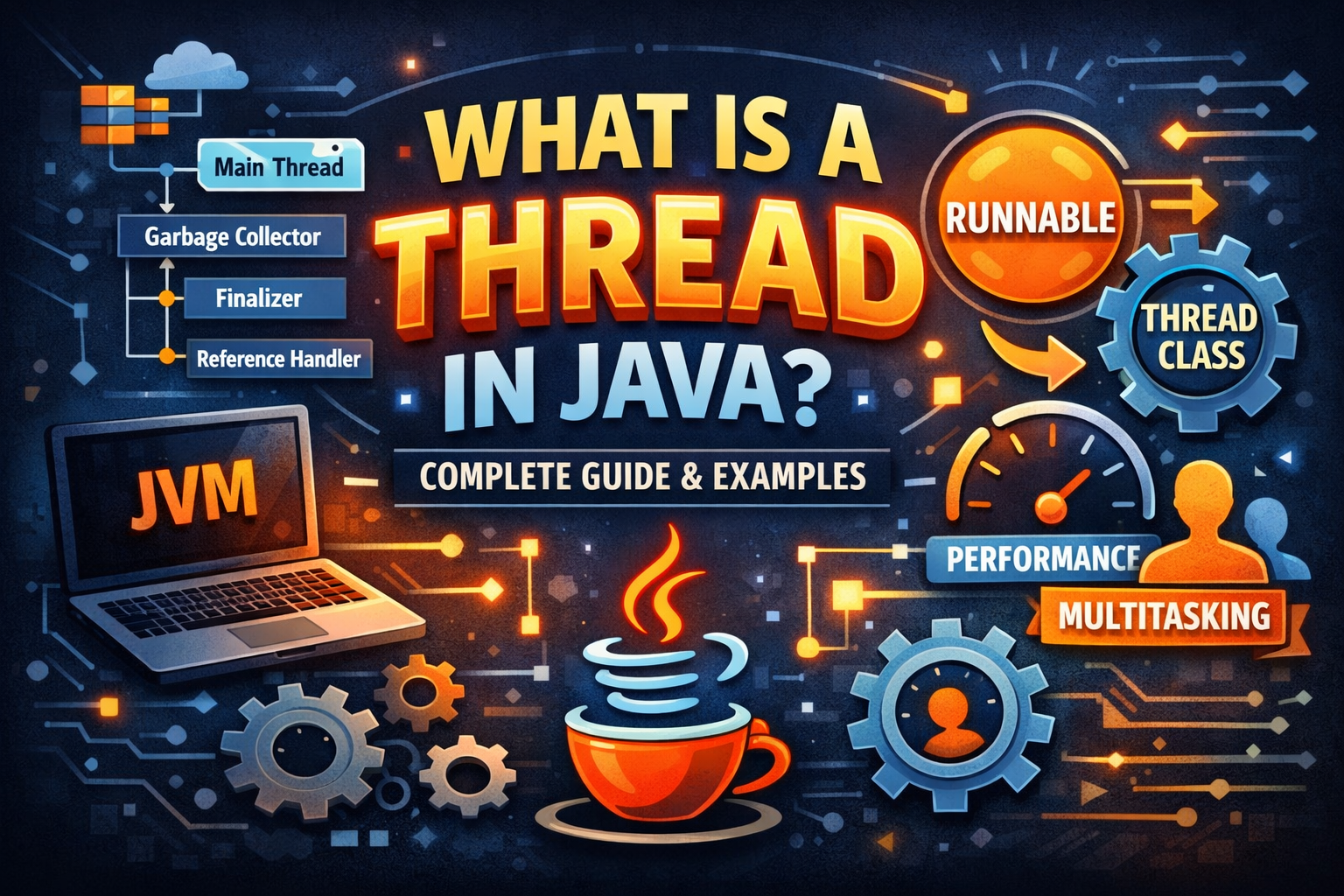
Thread in java
A thread in Java is a lightweight unit of execution that enables concurrent processing within a program. It helps improve performance, responsiveness, and efficient resource utilization. In this guide, we cover thread basics, lifecycle, memory model, and how to create threads using Thread class and Runnable interface with practical examples.