Artificial Intelligence
I’ve been writing software for more than 12+ years now.
In that time I’ve watched a lot of “next big things” come and go. Some technologies arrive with massive hype and disappear quietly a year later. Others show up almost silently and slowly become foundational infrastructure.
MCP feels like the second kind.
Over the last few months I’ve noticed more developers hearing the term “MCP Server” without fully understanding what it actually is. Some think it’s just another AI buzzword. Others assume it’s tied only to Claude.
Neither is really true.
So in this post, I want to explain MCP the same way I’d explain it to another engineer on a whiteboard — simply, practically, and without unnecessary hype.
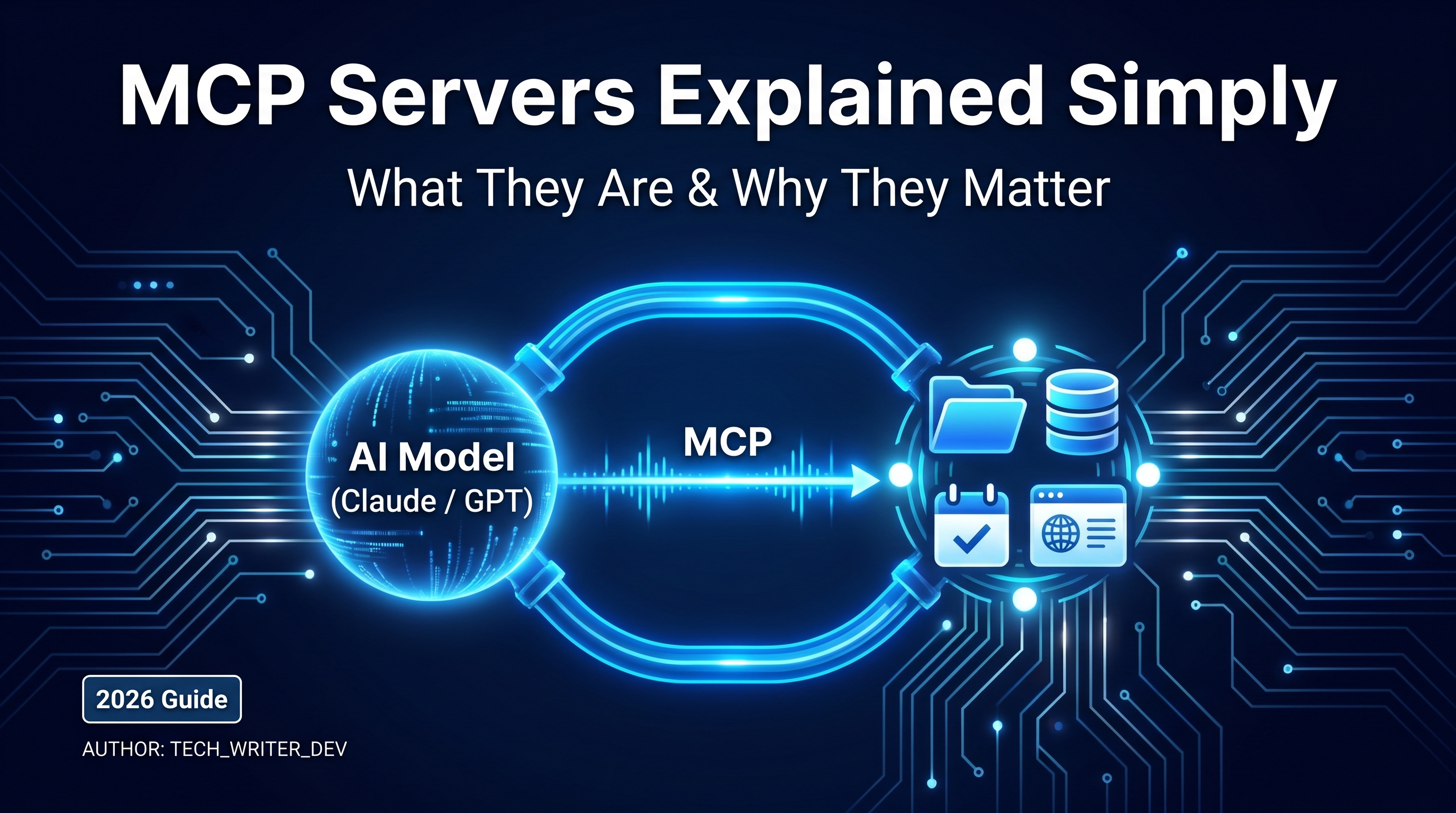
MCP stands for Model Context Protocol.
It’s an open standard created by Anthropic that allows AI models to communicate with external tools and systems in a standardized way.
That definition sounds technical, but the idea itself is actually pretty simple.
AI models are smart, but isolated.
By default, they cannot:
access your files,
query your database,
interact with Slack,
call internal APIs,
or perform actions in the real world.
MCP acts as the bridge between the model and those external systems.
That’s the core idea.
Before MCP, everybody was building custom integrations for AI tools.
Every company had its own:
wrappers,
function-calling setup,
connectors,
API glue code,
permission systems.
It worked, but it was messy.
MCP is basically trying to standardize that layer.
The easiest comparison is probably HTTP.
Before HTTP, systems communicated in lots of incompatible ways. HTTP created a common language for the web.
MCP is trying to do something similar for AI tooling.
That’s why people are paying attention to it.
An MCP Server is just a lightweight service that exposes capabilities to an AI model.
Those capabilities could be:
reading files,
searching the web,
querying a database,
sending messages,
fetching data from APIs,
or almost anything else.
The important thing is this:
The AI doesn’t directly interact with your systems.
The MCP Server sits in the middle and handles that interaction safely.
That separation matters a lot, especially for security and permissions.
Let’s say you connect an AI assistant to:
your GitHub repo,
documentation,
and Jira tickets.
Without MCP, you’d probably write a bunch of custom integrations manually.
With MCP:
each system exposes tools through MCP Servers,
the AI client connects to those servers,
and the model can use the available tools when needed.
So when you ask:
“Find all authentication-related bugs from the last sprint and summarize the affected code.”
…the AI can actually gather live information instead of relying only on training data.
That’s where things start becoming powerful.
This is where many developers initially get confused.
An MCP Client is the AI application itself.
For example:
Claude Desktop
AI agents
custom assistant apps
The MCP Client connects to MCP Servers.
The MCP Server exposes tools and resources.
One client can connect to multiple servers at the same time.
That’s how an AI assistant can simultaneously access:
files,
databases,
search,
APIs,
calendars,
and internal systems.
Personally, I think this is the important part.
AI models themselves are improving quickly, but eventually most models become “good enough.”
What will really differentiate AI products is the ecosystem around the model:
tools,
integrations,
workflows,
execution systems,
security layers.
That’s the layer MCP is trying to standardize.
And honestly, that matters much more long-term than most people realize right now.
Maybe a little.
Every emerging technology gets overhyped initially.
But underneath the hype, there’s also a genuinely important architectural idea here:
a standardized way for AI systems to interact with external tools safely and consistently.
That problem is real.
And it’s only going to become more important over the next few years.
I don’t think MCP is “magic.”
And I don’t think every developer needs to drop everything and rewrite their systems around it tomorrow.
But I do think it’s worth understanding early.
Because if AI agents continue becoming more capable, they will need reliable ways to interact with real systems.
That infrastructure layer has to come from somewhere.
Right now, MCP looks like one of the strongest candidates.
And if you’re building AI products seriously, there’s a good chance you’ll run into it sooner than you expect.
The future of infrastructure isn't about managing servers, deployments, or dashboards. It's about designing autonomous systems that can observe, decide, and act safely within defined guardrails. Discover how AI agents, Platform Engineering, Kubernetes, Azure, and MCP are reshaping the role of cloud engineers and DevOps teams.

Beyond chatbots and coding assistants, AI is beginning to change how science itself gets done. In 2026, AI is generating hypotheses, designing experiments, and accelerating discovery faster than most expected.

Multimodal AI — systems that process text, images, audio, and video simultaneously — is moving from research labs into enterprise workflows. Here's where it actually matters.